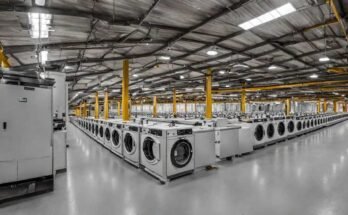
Many companies are looking for people with experience making tissue paper. Hire them. In this article, I will explain how tissue paper is made so you can apply it easily.
In this entire article, I will tell you how tissue paper is made. If you want to go into more detail about how tissue paper is made, click on our website Todayalljobs24.
Production unit
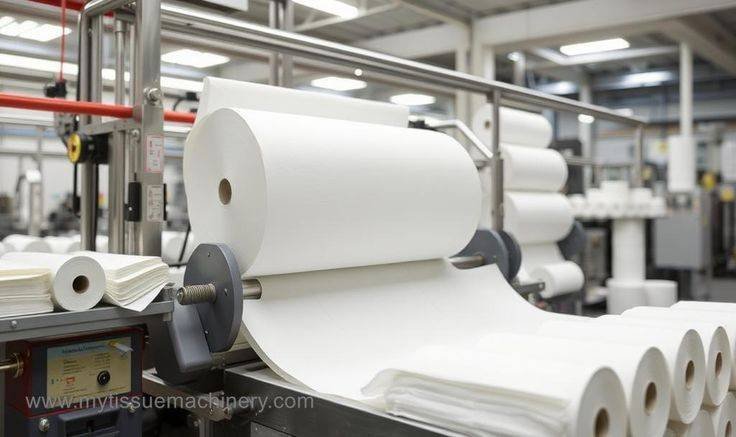
Production units are made of tissue reels, and imported wood pulp is used as the raw material, which is the basic component. First, the wood pulp is brought to the pulper section, and here it is fed into the pulping machine. This is the pulper machine, in which a chemical recipe is prepared. The solid wood pulp is converted into a liquid form here. For this, about 70 percent of the water in this container is used, and later pulp is added to it.
The chemical recipe is prepared. Then it is mixed here with an agitator, and the resulting mixture is shifted to the tail chest. These are large containers where the mixing process continues simultaneously so that uniformity is achieved. The pulp in a liquid form is prepared, and then the pulp prepared in the tail chest is automatically shifted to the refiner machine.
But before that, to remove the coarse particles, whether they are soil or any kind of dirt, there is a high-density machine through which it is passed and then passed through a refiner machine; the liquid pulp is prepared. Its strength is increased so that the tissue paper is strong. Then, if you want to make soft paper, a little recipe change is made for it.
Then, we will tell you how the refiner machine refines it, and then this liquid pulp is shifted. This whole process is amazing. Everything is done automatically. All of this is done through machines, and there is very little human interaction. Here, only these machines are handled by people sitting inside the rooms, and this whole process is run. Next, we will tell you about all the other machines that make large tissue paper reels.
This is another crucial part of the production unit, and it is quite noisy here because the machines are operating at high speed. As I mentioned, the refined liquid pulp is prepared in the pulping section and then transported via internal piping into “machine chests”—large containers. From there, the pulp is moved into the “headbox.”
This machine consists of several different sections. Looking at the headbox, it might appear as though there is a sheet present, but it is actually a “wire” (a mesh screen). The headbox functions by spreading out this liquid pulp. Essentially, there is a wire on one side and a “felt” on the other—the felt resembles a conveyor belt.
The wire and the felt come together at the point where the pulp is discharged from the headbox. This process ensures that the pulp is spread uniformly across the felt. Furthermore, as the pulp is squeezed between the wire and the felt, the water is pressed out. The tissue paper then adheres to the underside of the felt, and the sheet gradually moves forward toward a vacuum chamber.
The vacuum chamber extracts any remaining moisture. At this stage, the sheet is being processed—you can see vapors rising, as water is being removed. The significant amount of water present in the initial liquid mixture—which was about 70% water—is being extracted here. Following the vacuum stage, the resulting sheet is then directed toward the Yankee.
The material is then fed into another key machine—the main machine—which further dries it. Once dried, the paper moves forward to the stage where the finished tissue paper is wound into large reels. A cutter trims the paper sheet and separates it, passing the prepared sheet along. This is the primary machine from which the paper sheets emerge; they are then wound into large reels.
There is also a meter displaying certain figures, which indicate the daily production output—this factory produces approximately 98 tons of paper per day, with a daily production length of around 1,326 meters (or roughly 1,350 meters). Finally, these large, finished reels are transported to the rewinder section.
Rewinder section
Inside the rewinder section, all this shifting is done through an automatic crane, and then, when it is shifted, it is rewound inside the rewinder. The paper sheets that are coming out there are single ply, but Rose Petal, like the tissue paper we generally use, you must have seen that there are two plies, so here generally two-ply reels are also produced; three-ply reels are also produced, which is what Rose Petal is producing. Based on this, these rolls are converted into double-ply or triple-ply reels on top of these rewinder machines, and these reels are then shifted further to the packing section.
If you want to know more about the Rewinder section in detail, click on our website Todayalljobs24.
Packing section
If you would like to know what process follows the packaging section, please click on our website to find out: Todayalljobs24.
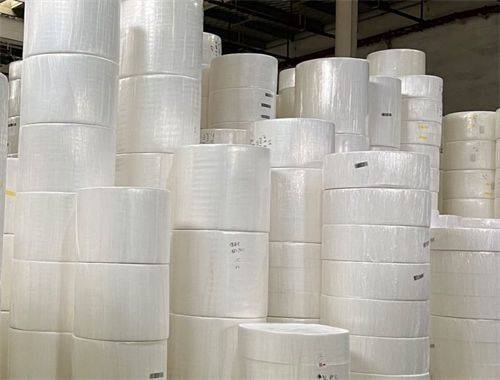
In the packing section, these large rolls are processed and then automatically transported to the next stage. This is the packing area where these massive rolls are placed; a skilled worker then attaches plastic wrapping material to them. The entire roll begins to move automatically, becoming completely encased in plastic. Once wrapped and packed, the rolls are moved to a warehouse—in fact, there are multiple warehouses where this stock is stored.
From here, it is supplied to various factories across Pakistan. Interestingly, the product is also exported abroad. Following this, the next phase—the conversion process—begins. But before we discuss that, let us first show you the warehouse, after which we will take you to the conversion unit, where 18 different varieties of tissue paper are produced.
Facial tissue Hall
Here, facial tissue papers are made, so these two-ply reels are made of tissue paper, which we told you how they are made. Well, for each tissue paper, there are different types of tissue paper. The reels that are made for them also have different chemical properties. Because the facial tissue paper that we have to use on the face is very soft, it is also made in a very refined way.
These reels are first put on the winding machines here with the help of a small crane, and then these two-ply reels are applied, and seven sheets are opened. Well, when we use it on tissue, we must have seen that the tissue paper is: when we take out one piece of tissue paper, the other one comes out automatically.
This happens in this way because when they are folded and applied, two first sheets are coming for it and these sheets are It is mixed and then put into this interfolder machine. Well, to put it into the interfolder machine, because these are big sheets, you have to cut them into small box sizes. So, first of all, this is an inversion, which marks it.
Its lots are made. For this, it will do edge and inversion marking, and after that, there is a cutter at the bottom. It is a very sharp cutter that will start cutting it into logs. According to the required size, which fits in it, it starts cutting the slot, starts making small pieces of it, and then these pieces are shifted to the packing department. Well, now you have seen that those logs are cut into one box at a time.
This machine is smart. This machine automatically separates the TC paper for each box. After separating, it shifts it. The packing material for packing is made into a box. So this company is quite good. The sales system is self-contained. Everything is made by itself. There are special sensors installed in this machine that detect if there are tissues in the box.
It automatically takes these papers from here and starts giving them the shape of a box. First, it will roll it from both sides to make a triangular shape. Here, the tissue papers will automatically start fitting inside the box. This whole process can be called a semi-automatic process in which manual workers are also working in some places. But all this work is starting to happen automatically. After that, when these packs start to be prepared, they are placed in cartons here, and then they are dispatched.
Tissue roll Hall
And here, three types of tissue rolls are made, one is cushion rolls, which are available in the market under the name of Zoop, apart from which their twider rolls and interest-selling toilet rolls are the largest-selling products, most Pakistanis use them everywhere, well, why are they available in the market under the name of Max Up, because they absorb maximum water, which is good for them, the special type of rolls are tissue rolls.
They are delivered here, and this whole hall is very automated. This work is being done by a single machine through a very automated system, so that there is less human involvement and less mess. When they come in every day, they are unwound; after being unwound, these rolls are glued together by a roller machine, and after gluing them, they are embossed by another roller, and a felt is applied on top of them.
The grains are felted on top. At the same time, this is because the issue paper roll inside a cover is being made, then the parallel side of it is being prepared here, and the cover is also being prepared in the same way.
These two reels are being glued to each other, and then in this machine, a rod is being bent so that this cover, which is a single roll, becomes a kind of mattress stick, and then it is collected in one place through a conveyor belt.
This cover is inserted, then inside this machine, where the tissue paper roll is being made, when it is inserted, it is then wound on top of this cover, and after winding, the logs of the stacks that are being prepared are shifted through a very beautiful conveyor belt, a machine is shifted through this into this cutter machine, and this cutter machine starts cutting the big logs into small rolls of toilet papers.
There are small toilet paper rolls that they have cut inside, and then this machine shifts them forward with a divider machine. What this divider machine does is distribute them into three different packaging lines, and in this way, this divider machine shifts these packages. They also explain the packaging process to you further, how they pack it in three different ways.
Toilet paper process
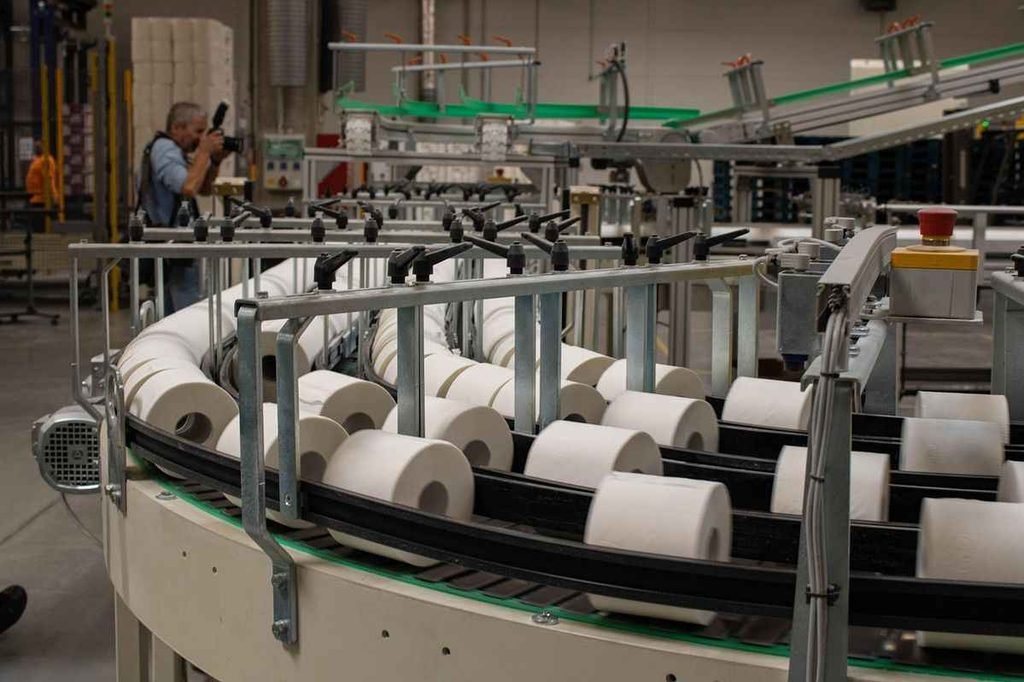
Once the toilet paper is ready, dividers direct it into three separate packing lines. There are three types of packaging: single rolls, twin packs (containing two rolls), and packs of ten rolls. As the toilet paper moves along, a packaging sheet wraps around it.
Simultaneously, an integrated printing machine marks the packaging with details such as the manufacturing date and price. From here, the packaged rolls are moved forward and placed into various cartons.
Another interesting point is that, within this same facility, ‘Rose Petal Professional’ produces large-sized toilet paper rolls—the kind often found in the restrooms of large shopping malls. Furthermore, as mentioned earlier, ‘Rose Petal Professional’ supplies napkins in large quantities to restaurants, hotels, and major food chains, featuring their specific logos and names.
They also manufacture paper cups. Since all these products are wood-based and designed with high hygiene standards in mind, the company places a strong emphasis on quality.
If you want to know more about the toilet paper process, click on our website Todayalljobs24.
So, in today’s article, I explain how toilet paper is made. If you would like to learn more details, please click on our website, Todayalljobs24.
https://worldpapermill.com/blog/tissue-paper-manufacturing-process
https://fay.com.pk/blogs/articles/tissue-paper-manufacturing-process