Many companies are looking for people with cutlery-making experience, so they should hire them. In today’s article, I will tell you how cutlery is made so that you can easily apply for this job.
If you want to know in detail how Larry’s goods are made, click on our website Todayalljobs24.
Cutlery is used for eating and cooking, so it is made especially from imported food-grade stainless steel sheets. Where I am now, not only are large quantities of stainless steel food sheets imported, but there is also a cutting machine that cuts the sheets into small pieces.
We convert large sheets into such sheets. These sheets are very heavy and of high quality. These sheets are imported especially from Germany, the US, and Japan, and then cutlery is made from them according to international standards.
Now this cutlery is exported all over the world. After cutting the food-grade steel sheet into small pieces, it is sent to the cutting press machine.
Cutting section

After food-grade stainless steel sheets are cut into smaller pieces, they are placed into a cutting press machine, where specific shapes are stamped out using a mold. Although these pieces are destined to become spoons, they do not yet resemble them—they are quite thick.
Consequently, they are immediately transferred to a rolling machine, where a skilled craftsman flattens them to ensure they are suitable for use while eating.
The metal is rolled out further until it becomes thinner. It emerges from the rolling machine warm, after which it undergoes additional shaping and further processing. This is how spoons and forks are manufactured.
If you want to know more about the cutting section, click on our website Todayalljobs24.
Trimming process
The item that emerges from the rolling machine is flat, but it still requires shaping—whether it is to become a spoon or a fork. For this purpose, a trimming machine is used, which shapes the piece according to a specific mold.
As you have likely observed, the bowl of a spoon is oval-shaped; it is given this form through this process. If you wish to produce a fork, a different mold is used, which trims the piece into the shape of a fork.
To get more information, click on this website: Todayalljobs24.
Designing section
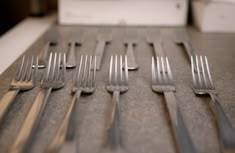
Once the spoon has been shaped, it is brought to this power-design machine. It is positioned underneath—a necessary step, as this is a very heavy-duty machine that applies significant force during the stamping process.
This action embosses the desired design onto the spoon, fork, or any other piece of cutlery. A large number of molds are kept here; these represent various unique designs that have been developed in-house and are officially registered. After the design has been imprinted and the final shape achieved, the item then undergoes a polishing process.
If you want to know more about the design section, click on our website Todayalljobs24.
Polishing section
Inside the polishing section and as I told you, there are three processes of polishing. First, the handle portion of the spoon, knife, or fork is polished, rubbed with a rag, and then its edges are polished.
Finally, there is the machine section where first they put the tools inside the tray, like the knife that is installed, it will first be polished inside this machine and then it is rubbed in this machine.
First, it is half-flipped, and then the same tray is shifted to another machine where buffs are applied, and it is fully polished, after which it takes the form of a final product, shining perfectly, but for the spoon and fork, it has to be processed further.
Printing section
After polishing, the company name is embossed on the product, just as you can see on it, New Friend is embossed, so anywhere in the world, if you see cutlery with New Friend written on it, it is made in the city of Wazirabad, Pakistan.
Interestingly, they also print the name by laser according to the client’s requirement, and then, after the name is printed, the final shape is formed; for example, a spoon is bent using bending machines. Interestingly, a spoon goes through three processes to be bent.
First, its shape is bent on this machine. It is a little flat, but now you will see a bend in it. But it is not the shape of a spoon. It will not raise your soup or rise properly.
Therefore, it is further bent on this machine, where it has already taken the shape of a spoon, but its handle will be a little higher. Then, its handle is bent.
That is also banded, and this band is reduced a little. After that, our spoon is ready. But for the fork, there are machines that first finish the fork after grinding it, which is its inner part. After this finishing, its inner part is ground through various processes in a rag mill.
Its surfaces are smoothed. Finally, the finished products are put through the process of final polishing; they are rubbed once again with a rag mill, and then they are brought to the washing section.
Washing section
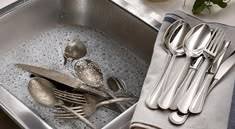
And then it is brought to the washing section, where it is first dipped in an imported Japanese chemical for five to 10 minutes.
What happens in this is that all the contamination, because dirty hands are also touching the machine during the process and also the contamination is touched, so all the contamination is removed. After zero contamination, it is then shifted here to the packing section.
Packaging section
Here are very beautiful Made in Pakistan Utensils cutlery sets which are packed after being prepared. Very interesting.
Here too, its visual quality is first checked to see if its brand is correct, its look is correct, and it has been cleaned properly. Then it is first packed in plastic and then packed inside boxes and exported all over the world.
So in today’s entire article, I told you how cutlery is made. If you want to know more details about how cutlery is made, then click on our website Todayalljobs24.